





Ranking News
Shanghai Announces Best Chinese Universities
Shanghai Ranking has announced the latest edition of the Best Chinese Universities Ranking. The leader is Tsinghua University, followed by Peking University, Zhejiang University, Shanghai
QS Subject Rankings: Excellent Performance from Harvard, MIT and Oxford
QS Quacquarelli Symonds (QS) have announced the results of their World University Rankings by Subject 2024. These provide rankings of five broad and fifty-five narrow
Elsevier (UK), ECLBS (Latvia) and TUIT (Uzbekistan) join IREG as members
The IREG Observatory General Assembly by electronic vote admitted the following new members: Elsevier Ltd, (London, UK) A global publisher of scientific journals, leader in
IREG 2024 Conference in Bucharest, Romania 7-8 November
Waldemar Siwinski, president of IREG recently visited Bucharest where he met with Prof. Remus Procopie, rector of the SNSPA University and high-ranking representatives of Romania’s
Research in University Rankings
An article by Irfan Ayhan of Sabanci University, Istambul, Turkye, ‘Research Trends in University Rankings: A Scoping Review of the Top 100 Most Cited Articles
University of Zurich Withdraws from THE rankings
The University of Zurich has announced that it will no longer submit data to the Times Higher Education (THE) World University Rankings and their various
SCImago’s Ranking has New Social Metrics
The SCImago Institutions Rankings are published by a company that is a spin-off from the SCImago Research Group, an organization supported by the Spanish National
New Ranking from Iran
The Islamic World Science and Technology Monitoring and Citation Institute (ISC) was established in Azerbaijan in 2008 and is now based in Iran. It has published
Changes to the Carnegie Classification
The Carnegie Classification of Institutions of Higher Education was first published in 1970 and is currently produced by the American Council on Education (ACE) and
Rector of IREG member, appointed Minister of HE of Uzbekistan
Kongratbay Sharipov rector of Tashkent State University of Economics has been appointed Minister of Higher Education, Science, and Innovations of the Republic of Uzbekistan. Tashkent
CWTS Leiden Publishes First Open Ranking
The CWTS (Centre for Science and Technology Studies) at Leiden University has announced a significant step forward in its quest for transparency and honesty in
Latest Reputation Ranking from THE
Times Higher Education (THE) has published the latest edition of its reputation rankings. This is based on a survey of researchers who were published in

PhD on Rankings
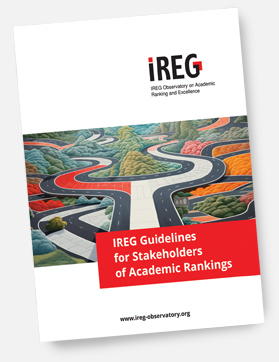
IREG Observatory on Academic Ranking and Excellence competition to recognize an outstanding PhD conducted in the area of academic ranking.
IREG Initiatives
IREG Inventory
of international rankings
The purpose of “IREG Inventory of International Rankings” is to collect and make available on the IREG Observatory on Academic Ranking and Excellence website information on the current state and scope of this important group of rankings.
Recent comments
“The Times Higher Education Impact Rankings was announced on Wednesday,
April 22 2020. “
Cesar Wazen
Director of International Affairs Office at Qatar University
Conferences by IREG
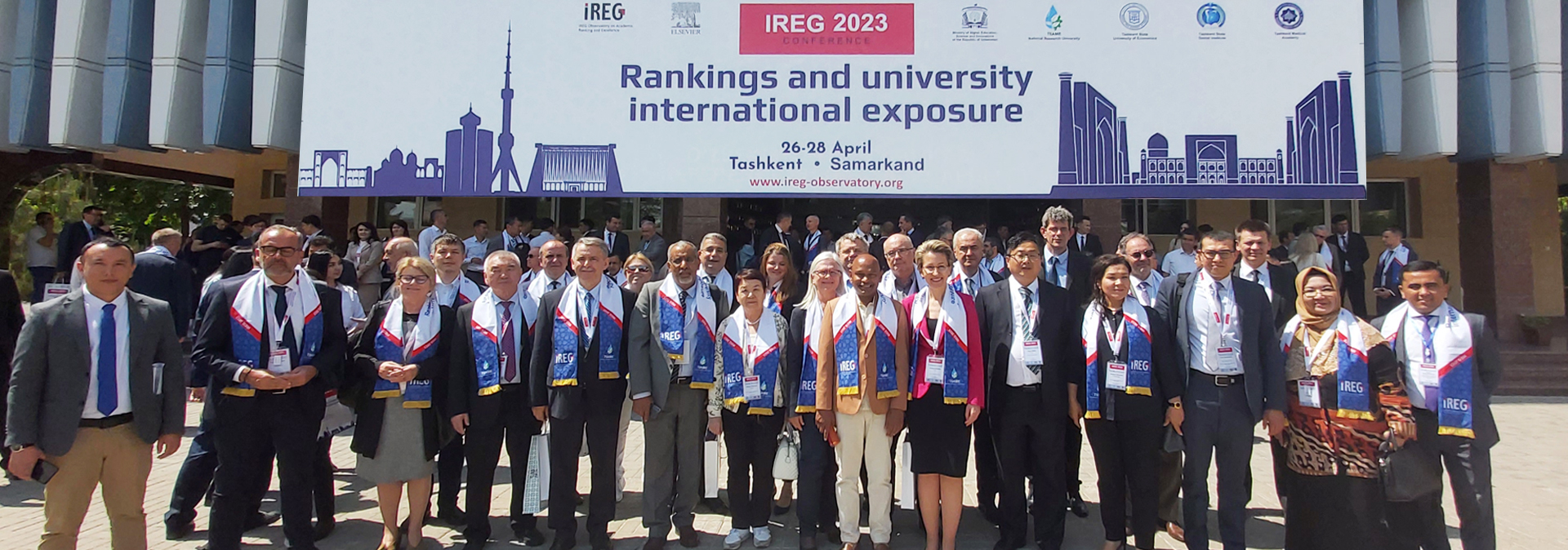
IREG 2023
Conference
Rankings and University International Exposure
Tashkent/Samarkand 26-28 April 2023
IREG 2021
Jeddah Conference
Effects of Rankings on Community and Society
virtual/15-16 November 2021
News from Ireg Members
Polish universities are aiming high!
A short video Polish Universities – Aiming High, produced by the Perspektywy Education Foundation, tells about steps of ambitious higher education institutions in Poland taken
Bejing University of Technology
Bejing University of Technology published a Report on its activities in the period 2016 – 2020.
Poland’s institutions top new European Ranking of Engineering Programes (EngiRank)
Warsaw University of Technology and AGH University of Science and Technology in Krakow secured the first and second place in the European Ranking of Engineering Programs
Invitation for female students and PhD candidates in IT
Join the biggest event for women in technology and IT in Europe. The online Perspektywy Women in Tech Summit (8-9 December 2020) will be a
Al-Farabi KazNU aims to be a research university
The Academic Council of university Al-Farabi KazNU, Almaty, Kazakhstan announced a new program for the strategic development of the University until 2025. Al-Farabi KazNU aims